
When considering Oracle products for high availability, data protection, and disaster recovery solutions, Data Guard is designed to fulfill these roles. In general, it enables disaster recovery through failover, that is, the transition of roles between databases, and allows maintenance operations without data loss through switchover, meaning the reversal of roles between databases.
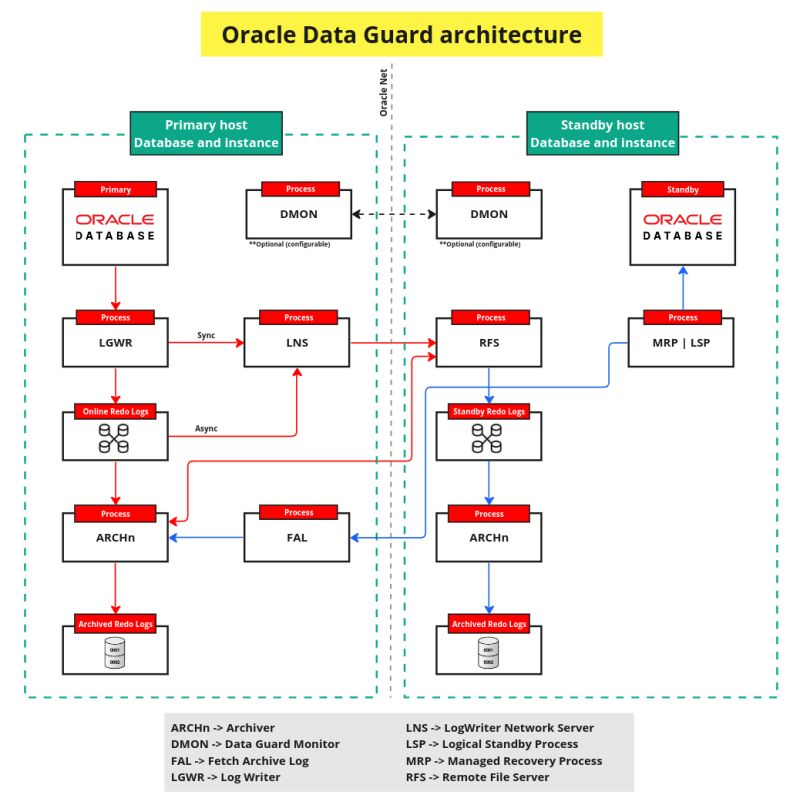
Starting from an Oracle database of interest, which will act as the primary database, it is possible to configure Data Guard. This results in at least one additional database, known as the standby database, and communication between Data Guard members occurs via Oracle Net. The operation of Data Guard can be summarized as follows:
- REDO data generated in the primary database (originating from transactions and database activity) is transported to a standby database to keep it updated. This transport can be synchronous or asynchronous (sync | async), which impacts the maximum protection, maximum availability, and maximum performance modes that can be configured for Data Guard.
- Once the redo data reaches the standby environment, it is applied to the database by the MRP process in the case of a standby database, or logically converted by the LSP process and then applied in the case of a logical standby.
- If missing archived redo log files are detected on the standby, these files are requested through the FAL process to resolve update gaps between the databases.
- Optionally, the standby can be managed using Data Guard Broker. In such cases, the DMON process operates using predefined configurations and executes commands received through a client.
Observação: A arquitetura do Data Guard pode ser observada em uma imagem anexada à essa publicação.
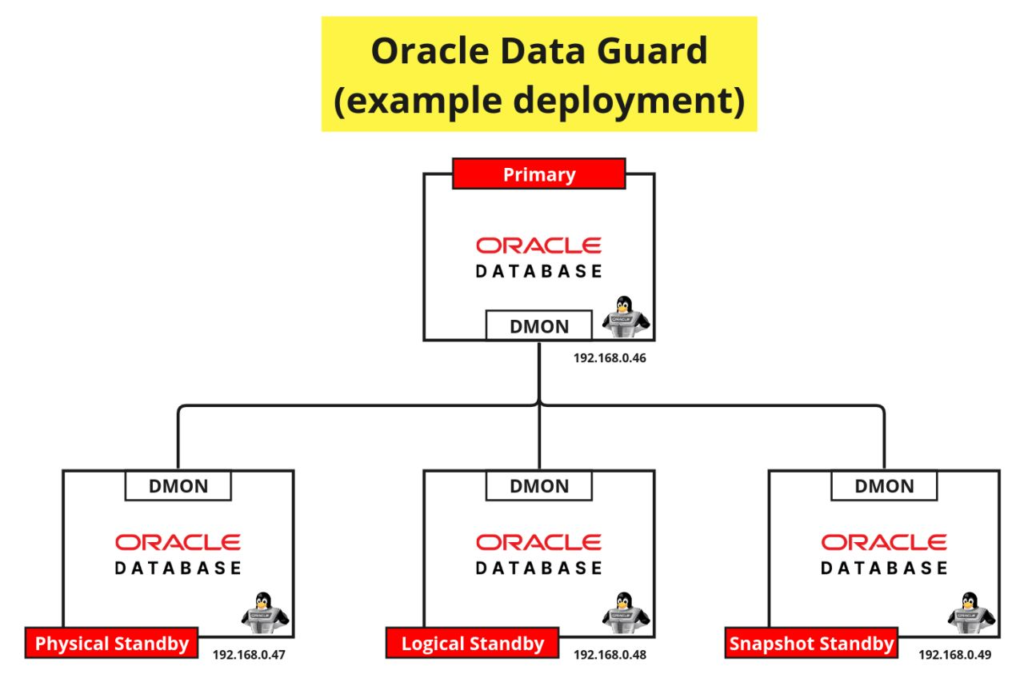
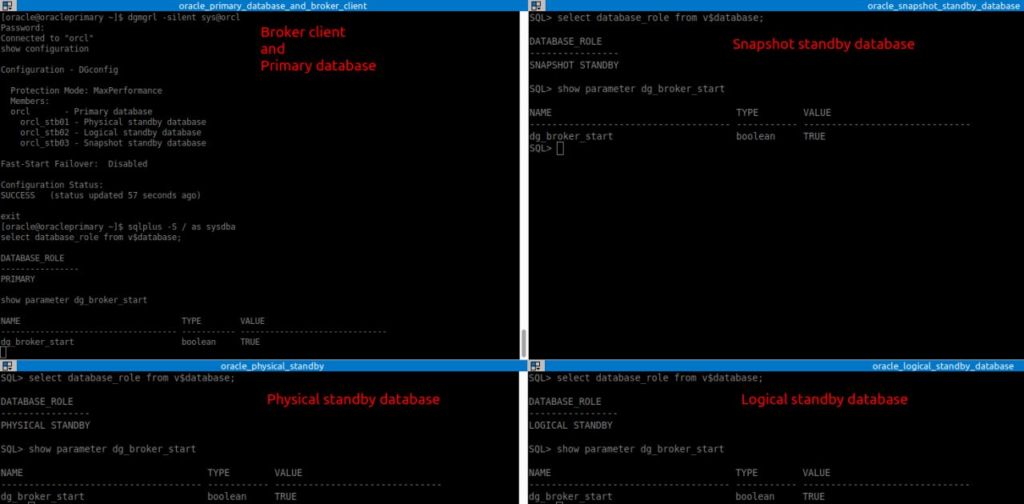
I created a general and simple configuration scenario covering the three types of standby databases (physical, logical, and snapshot) managed by Data Guard Broker, which can be seen in two images attached to the post. The configurations were performed in Oracle Linux 7.9 environments with Oracle Single Instance Multitenant databases.
In addition to proper configuration and disaster recovery planning to ensure Data Guard functionality, it is essential to monitor and track its operation. This ensures that environments remain up to date, helping to mitigate and eliminate errors and potential delays, and ensuring successful failover and switchover operations.
Oracle Data Guard is one of the Oracle solutions within its high availability architecture, highlighting its ability to integrate with other products, for example, Data Guard in a RAC environment and the creation of a Downstream Mining Database using Oracle GoldenGate on standby databases.
Reference
Linkedin: Reviewing some characteristics and the importance of Oracle Data Guard (DG).